
White County Arrest Records and Court Charges
White County arrest records are sheriff or police records tied to an arrest, booking, incident, or custody event. The Sheriff's Office open-records form includes arrest and booking reports, incident reports, accident reports, photos, audio, video, and other records. Those records are not the same as the court charge record. After an arrest, the prosecutor decides what formal charges to file, and the court docket tracks those charges through arraignment, plea, motion practice, dismissal, reduction, conviction, or sentencing.
The sheriff side answers who was arrested, what record the agency created, and whether booking material can be requested. The court side answers what charges were filed, which court has the case, what status each charge has, and what final result was entered. For custody and jail-status details, use the White County inmate records route. For the full court case and outcome, use the White County criminal court records page.
The White County Sheriff's Office page is the local starting point for sheriff records, public records, current inmates, and related services.
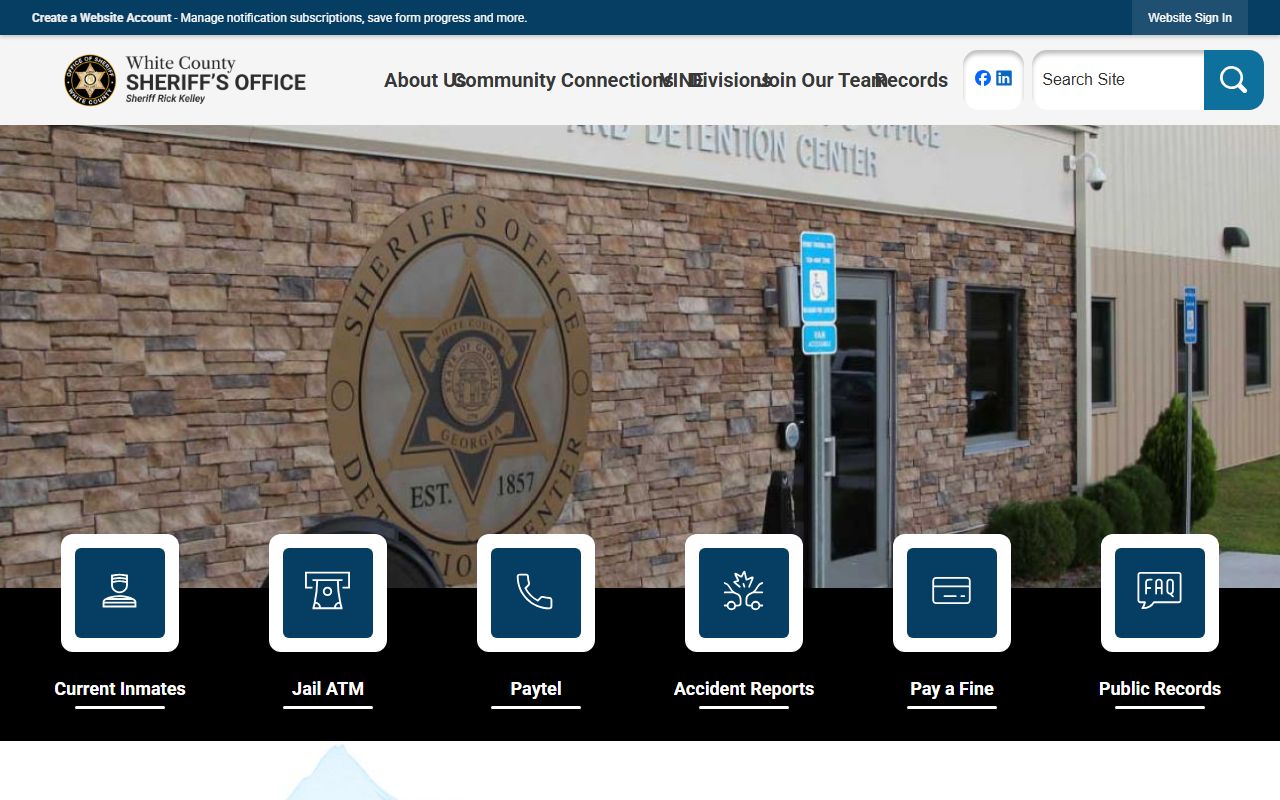
Sheriff records can document an arrest, but the charge status must be checked in the court or prosecutor record.
Find White County Arrest Records and Charges
White County's official current-inmates page says the online inmate list was temporarily disabled after scams targeted inmates and family members. For current custody, the page says to call the Sheriff's Office. For arrest or booking reports, use the Sheriff's Office open-records form. For court charges after arrest, identify the court: Superior Court for felony and serious criminal matters, Magistrate Court for criminal warrants and listed misdemeanor matters, Probate Court for misdemeanor traffic and game or fish violations, or a municipal court for Cleveland or Helen city citations.
- Start with the arresting agency and request arrest or booking records through the proper sheriff or city records channel.
- Check whether charges were filed in Superior, Magistrate, Probate traffic, Cleveland Municipal, or Helen Municipal Court.
- Use the Clerk of Court or court office for charge lists, docket entries, pleas, dispositions, and certified copies.
- Use the District Attorney or municipal prosecutor channel when an open or pending report must be reviewed before release.
- Use GBI record restriction guidance if the arrest did not result in conviction or may qualify for restricted access.
The White County Sheriff's Office open records request form is the specific route for sheriff arrest and booking report requests.
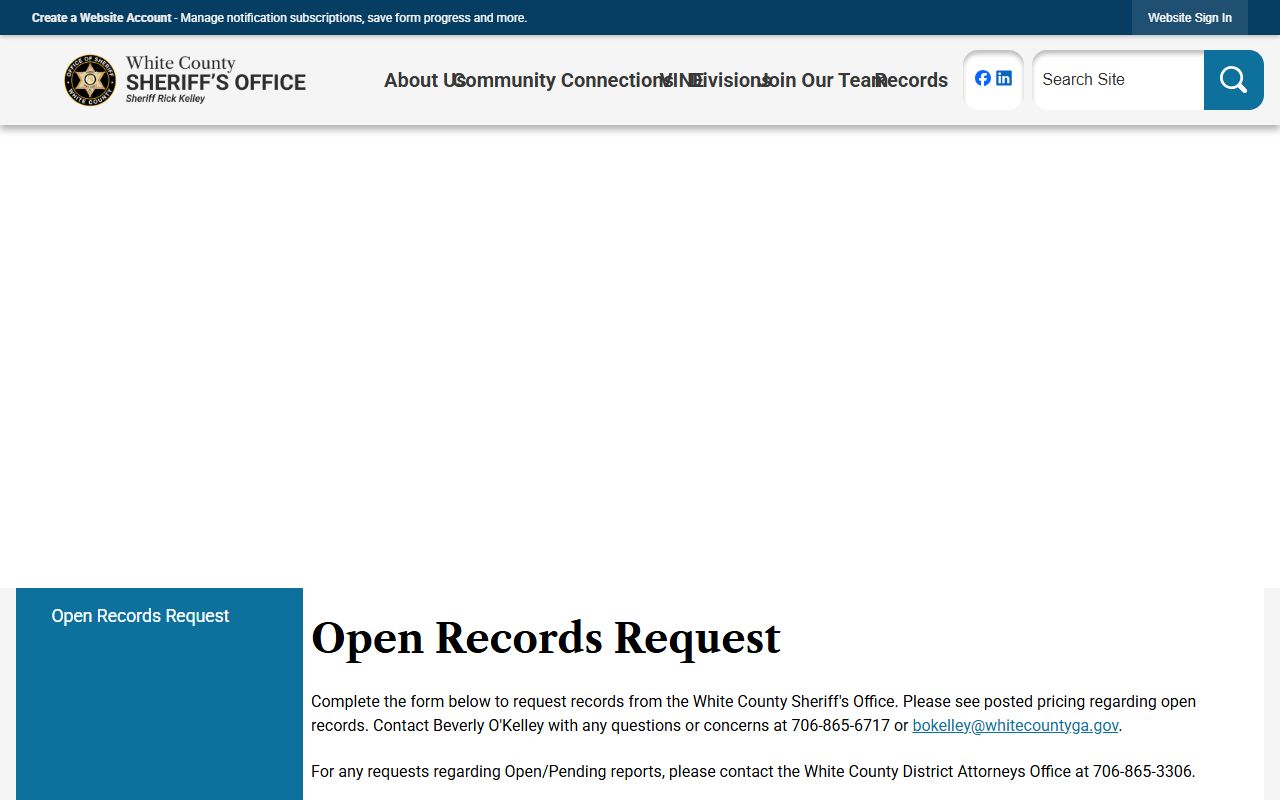
That sheriff request channel should not be replaced with the general county open-records form or the Clerk's court-copy process.
Charges Filed After a White County Arrest
The charge record begins when a charging document or citation places an accusation before the court. The exact document depends on case type and court. An officer's report can support probable cause, but the prosecutor or court process controls what formal charges proceed. In White County felony and serious state matters, the Enotah Judicial Circuit District Attorney prosecutes the case. Municipal and traffic matters may follow the city or probate path instead.
| Complaint | Accusation / Information | Indictment | |
|---|---|---|---|
| Filed by | Officer, complainant, or prosecutor depending on matter | Prosecutor | Grand jury |
| Common use | Warrants, lower-court matters, or initiating allegations | Many Georgia non-indictment criminal prosecutions | Felony matters requiring grand jury action |
| Where tracked | Magistrate, municipal, or later court file | Court case file and docket | Superior Court criminal record |
| What to verify | Whether it led to filed charges | Charge list and status | Counts, statute references, and disposition |
White County Charge Status Terms
Charges can change after filing. One arrest can lead to several counts, and each count can have its own status. A charge can be pending while the case is open, amended when the language or statute changes, reduced when the prosecutor or court moves it to a lesser offense, dismissed when it is ended, or nolle prossed when the prosecutor declines to proceed. A case may also be dead docketed, which places it inactive and can affect restriction questions.
| Status | What It Means |
|---|---|
| Pending | The charge remains open and has not reached final disposition. |
| Amended | The filed charge or wording changed after filing. |
| Reduced | The charge was lowered to a lesser offense or severity level. |
| Dismissed | The court ended the charge without a conviction on that count. |
| Nolle prosequi | The prosecutor declined to continue the charge, usually by formal entry. |
| Dead docket | The case is inactive but may not be the same as a dismissal or restriction. |
White County Charges vs Convictions
Being arrested or charged is not the same as being convicted. White County arrest records may show that law enforcement booked a person or created an incident record. A court charge record may show that an offense was filed. A conviction appears only after a guilty plea, accepted nolo plea where applicable, verdict, or other court result that legally supports a conviction. Reading only the arrest entry can miss later dismissals, reductions, acquittals, or record restrictions.
| Charge | Conviction | |
|---|---|---|
| Stage | Allegation filed after arrest or citation | Final result after plea or verdict |
| Where found | Charging document and court docket | Disposition, judgment, and sentencing record |
| Can change | Yes, it can be amended, reduced, dropped, or dismissed | Can be appealed or affected by later court action |
| Best proof | Filed charge list from the court | Certified disposition from the court custodian |
Statewide Charge and Registry Lookups
State tools cover different records than White County court charge files. The GBI sex offender registry is a state-maintained registry under O.C.G.A. 42-1-12. It is not a jail roster and not a complete arrest-record search. The Sheriff's Office sex-offender page points users to the state registry. The registry may show offender name, photo, address, offense, conviction or jurisdiction details, descriptors, and compliance information depending on the profile and current public data.
The GBI sex offender registry information page explains the state repository role for Georgia registry records.
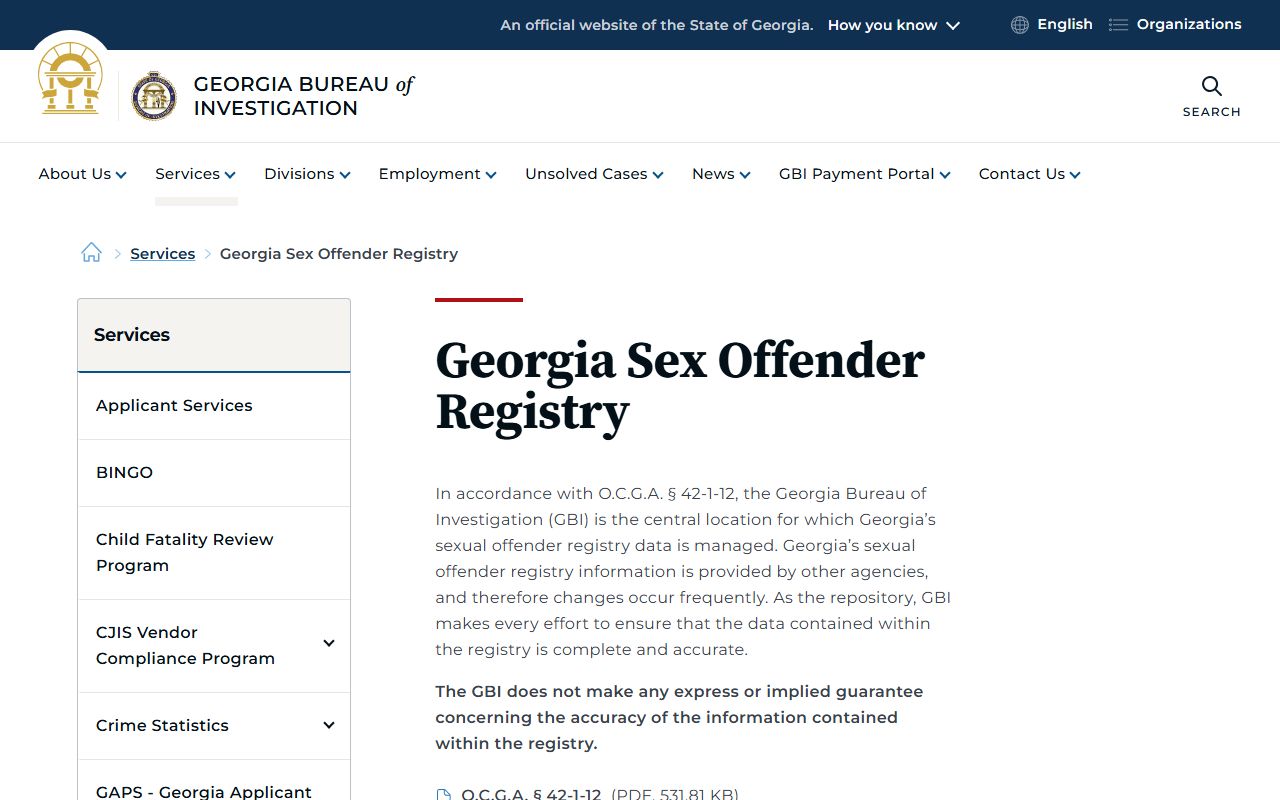
Registry information can be relevant to a prior conviction, but it should not be treated as a current arrest or charge list.
The Georgia sex offender registry search portal is the public search tool for the state registry.
For White County court charges after arrest, use the registry only when the charge or conviction falls within registry law.
White County Charge Codes and Severity
Charge codes point to the law allegedly violated. In White County, a charge might be a felony handled in Superior Court, a listed misdemeanor in Magistrate Division, a misdemeanor traffic citation in Probate Court, a municipal ordinance case in Cleveland or Helen, or a game or fish violation in Probate Court. The court level often tells the reader how serious the matter is, but the final result comes from the disposition and sentence, not the label alone.
Some White County misdemeanor records named in the Magistrate Division research include shoplifting over $500, possession of marijuana over one ounce, furnishing or distributing alcohol to a person under 21, criminal trespass, misdemeanor deposit account fraud, and refund fraud over $500. More serious traffic crimes can become criminal court records. City ordinance and traffic charge codes should be checked with the municipal court that issued or processed the citation.
Access to White County Arrest Records
Sheriff arrest and booking records are requested through the Sheriff's Office open-records form. The form asks for requestor contact information, type of record requested, dates, location, person involved, approximate time, case number if known, and an acknowledgment of possible fees under the Open Records Act. It includes checkboxes for incident reports, incident audio or video, accident reports, accident video, photos, arrest or booking reports, and other records. Accident reports have extra requester-status choices under O.C.G.A. 50-18-72(a).
White County's general county open-records form should not be used for Sheriff's Office records, court records, District Attorney records, Clerk records, divorce records, real estate records, or Probate Court marriage licenses. The Sheriff's form says open or pending report requests should go to the White County District Attorney's Office number published by the county. If the record sought is a court charge, docket entry, plea, disposition, or sentence, use the court or clerk custodian instead.
Note: An arrest report can be public in part while active investigations, victim data, juvenile data, or protected identifiers remain limited.
Restricted White County Charge Records
Georgia record restriction can apply to eligible criminal-history records under O.C.G.A. 35-3-37. For arrests after July 1, 2013, GBI says the person usually contacts the prosecutor if the arrest did not lead to conviction or otherwise qualifies. For arrests before that date, GBI says the person applies through the arresting agency. Cleveland's city site also links a request to restrict an arrest record under police and municipal court resources, which is relevant for Cleveland Police arrests.
| Restricted / Sealed | Not Publicly Removed | |
|---|---|---|
| Public access | Limited by statute, court order, or approved restriction | Visible unless a legal limit applies |
| Common records | Juvenile, adoption, sealed, eligible non-conviction, victim-sensitive data | Ordinary adult charges, dockets, and dispositions |
| Who reviews | Court, prosecutor, arresting agency, or GBI depending on record | Custodian still controls copy and certification rules |
| Key point | Restriction may limit public dissemination | It does not prove the arrest or case never existed |
White County Background Check Limits
A casual arrest or charge lookup is not the same as a lawful employment, tenant, credit, insurance, or licensing background check. The Sheriff's FAQ describes a local criminal history process requiring in-person consent, a driver's license copy, a $10 exact-cash fee, and weekday service. Court records may show charges and dispositions, while criminal-history records may be governed by separate state rules and restriction procedures.
For screening or legal use, the safest record is a certified court disposition from the court custodian plus any authorized criminal-history response from the proper agency. A charge without a disposition can be misleading. A sheriff booking report without the later court record can also be misleading. Read the arrest, charge, disposition, and sentence together before drawing conclusions.
Important: Do not use casual arrest or charge lookups for FCRA-regulated screening decisions.